




 Nederlands (nl-NL)
  English (United Kingdom)

The @European Commission’s Open Source Observatory (OSOR) recently published the 2026 Paper on Progress and Trends in the National Open Source Policies and Legal Frameworks. This paper examines the evolution of the adoption of open source software and related policies in European public administrations.
Read the full paper: https://openforumeurope.org/publications/progress-and-trends-in-the-national-open-source-policies-and-legal-frameworks-3/
Publications & Patents
Scientific publications
- Aad Offerman and Ad J. van de Goor: An Open Notation for Memory Tests (presented at the IEEE International Workshop on Memory Technology, Design and Testing, 1997)
- Aad Offerman and Ad J. van de Goor: An Open Notation for Memory Tests (Technical Report No.1-68340-44(1997)07, Delft University of Technology)
- Ad J. van de Goor, Aad Offerman, and Ivo Schanstra: Towards a Uniform Notation for Memory Tests (presented at the European Design & Test Conference and Exhibition 96)
See web page on semiconductor memory testing for detailed information and citations.
Other publications
- project report 'Development of a Funding Mechanism for Sustaining Open Source Software for European Public Services', April 2022
- report 'IPv6-inventarisatie, september 2018: Achterstandspositie IPv6 en kortzichtige houding branche vormen probleem voor de BV Nederland', a market adoption analysis and report for .nl registry SIDN
- report 'DNSSEC-inventarisatie, februari 2017: DNSSEC-beveiliging Nederlandse domeinnamen onder de maat', a market adoption analysis and report for .nl registry SIDN
- book 'Hands-on: OpenVPN; Installing and configuring an OpenVPN server and gateway, and setting up OpenVPN clients on Linux and Android' (Private and Secure Computing), ISBN 978-1503048485, November 2014
- paper 'Public Open Source Software Procurement Models: The Next Generation', published in the European Journal of ePractice, issue No.18 on New Business Models for Public Services, October 2012
- three chapters of the book 'Get Ready for Cloud Computing; A Comprehensive Guide to Virtualization and Cloud Computing' (Van Haren Publishing, Jan 7th, 2011, ISBN 978-9087536404)
Patents
- EU patent 008315642-0001: aluminum soldering tabletop
Adding NoAI and NoImageAI robots meta tags to your Joomla 4 website
As well as blocking CCBot and GPTBot using robots.txt
In reaction to robots freely crawling the web and incorporating every valuable asset they find into (closed) AI models, creatives (platforms) have introduced new robots meta tags to denote that they do not want their content to be worked into these models.
One reason is that creators consider "incorporating into an AI model" in itself as an infringement of their copyright. Another reason is that AI models are known to sometimes be able to produce (clearly) recognizable parts of the original works, which then become part of work produced by users of the AI model.
In this article we show how you can add the 'robots noai' and 'robots noimageai' meta tags (invented by DeviantArt) to your Joomla 4 website.
We also show you how to stop OpenAI's web crawler from processing (parts of) your site, using the robots.txt file.
Lees meer: Adding NoAI and NoImageAI robots meta tags to your Joomla 4 website

Configuring MAME on Fedora Linux
Finally sat down to properly configure MAME on my Fedora workstation.
Here is what I did and found out:
- MAME contains only emulators (machines), no games (ROMs), so the default ROMs directory
/usr/share/mame/roms/is empty - as an ordinary user, you create your personal ini file
~/.mame/ini/mame.ini(start with a copy of/etc/mame/mame.ini) and add your directory$HOME/.mame/romsto therompath, which allows MAME to find your ROM files
Adding an arrow icon to external links in Joomla
Many websites automatically add an arrow icon to links pointing to external addresses. Most notable example is Wikipedia, but there are many other sites that do the same.
Here is what I did to add similar arrows to my Joomla-based website.
Programming in R: adjusting USD prices for inflation
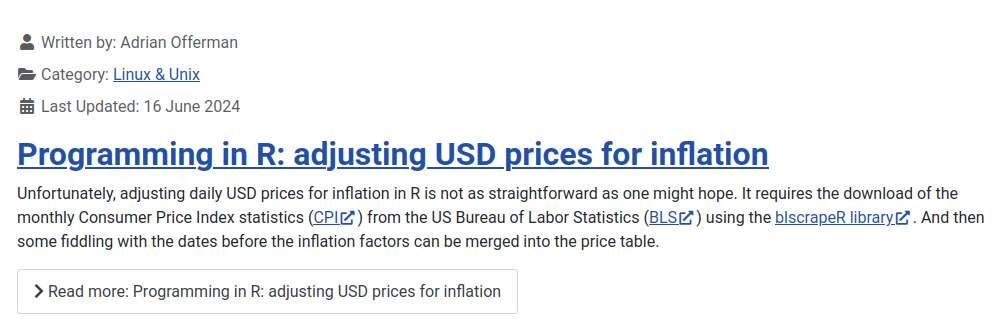
Unfortunately, adjusting daily USD prices for inflation in R is not as straightforward as one might hope. It requires the download of the monthly Consumer Price Index statistics (CPI) from the US Bureau of Labor Statistics (BLS) using the blscrapeR library. And then some fiddling with the dates before the inflation factors can be merged into the price table.
Lees meer: Programming in R: adjusting USD prices for inflation
Pagina 2 van 5